Knowledge
Paper medicine cups, PFAS and the SUP Directive
A paper medicine cup looks like an easy step away from plastic. But many paper cups have a lining to make them watertight. What is in that lining, and which EU rules apply to it?
Why paper cups have a lining
Updated 10 October 2026.
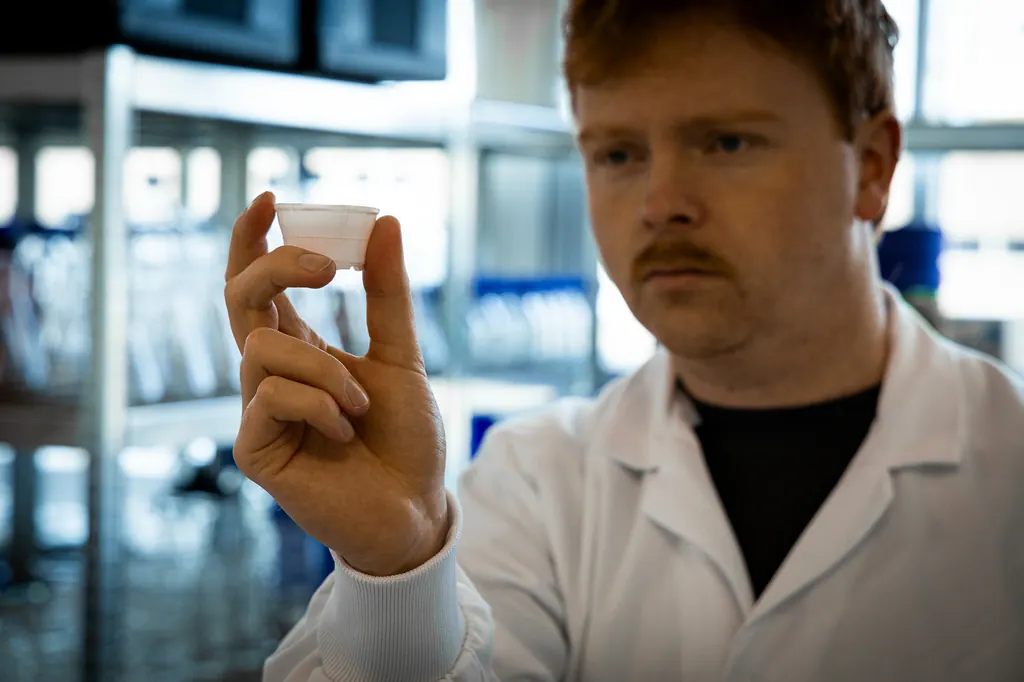
Paper absorbs moisture. A cup of plain paper goes limp when it holds syrup, water or a dissolved tablet. That is why paper cups often get a barrier on the inside. That barrier can be made in two ways.
- A plastic layer. Often a thin layer of polyethylene (PE). The cup is then paper with plastic.
- A PFAS treatment. PFAS make paper repel grease and water. You mainly see this in paper and board for food.
From the outside you usually cannot tell which of the two it is. That is why it pays to ask your supplier.
What does the SUP Directive say?
SUP stands for single-use plastics. With this directive the EU aims to cut single-use plastic products and litter. The Directive does not only look at products made entirely of plastic. A product with a thin plastic layer counts too.
Paper disposable cups often have a plastic coating to make them watertight. Under EU rules that makes them a single-use plastic product. Source (details and source) Under the SUP Directive, bioplastics such as PLA count as plastic too. That applies even if they are made from plants or are biodegradable. Source (details and source)
Switching from plastic to paper with a plastic lining therefore does not take a cup out of the SUP Directive. For some product groups, such as cups for drinks and food containers, the Directive asks countries to take extra measures. Whether and how those apply to medicine cups depends on the product and on how your country implements the rules. Check with your supplier or your procurement adviser.
What are PFAS?
PFAS is the name for a large group of man-made substances. They repel water, grease and dirt. That is why they are found in many products, from rain jackets to non-stick pans. PFAS hardly break down in nature. That is why they are also called forever chemicals. Some PFAS are harmful to health and build up in people and in the environment.
PFAS used to be common in paper and board for food, because they keep grease out. A paper medicine cup can have the same treatment. The only way to be sure is to have it measured.
Which PFAS rules apply?
Since 12 August 2026 the EU Packaging Regulation has restricted PFAS in food-contact packaging. This applies to food-contact packaging. Source (details and source) The Regulation works with limit values for PFAS in the material. A maker must be able to show that its packaging stays below them.
Whether a medicine cup falls under this rule is not a given. A medicine is not food, and a cup on the ward is not always packaging. Still, the rule is a good yardstick. If PFAS are no longer allowed in a cup for coffee, you probably do not want them in a cup for medicines either. Europe is also working on a broader restriction of PFAS, covering many more products.
What to ask your supplier
Do you buy disposable cups for a hospital or care organisation? Ask these questions before you switch. They apply to every material, including ours.
- What is the cup made of? Does it have a lining or coating, and what is that made of?
- Has PFAS been used intentionally, in the cup or in the lining?
- Has the cup been tested for PFAS or for total fluorine? Ask for the laboratory report.
- Does the supplier consider the cup to fall under the SUP Directive? Why or why not?
- Is the material allowed to come into contact with food, and is there a declaration for that?
- Has the cup been tested with the medicines, drinks and pill crushers you use?
- Where does the cup go after use, and does that fit your hospital's waste streams?
Unsure about the answers? Discuss them with the hospital pharmacy and the department that handles waste and sustainability.
And our cup?
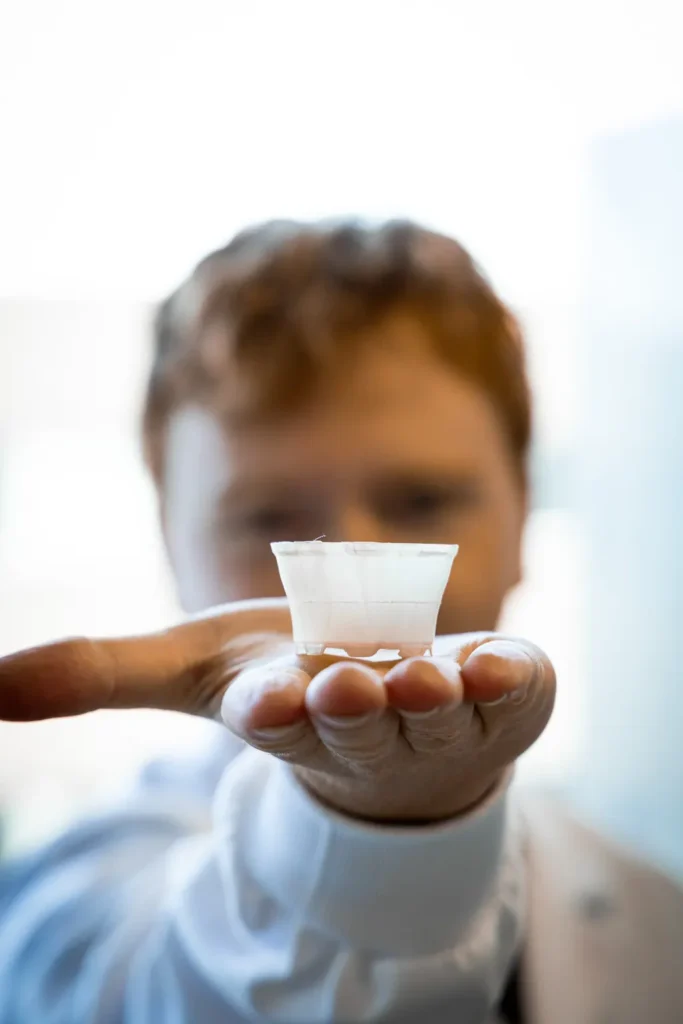
The same questions apply to us. This is what we can say today. The cup is made of cellulose, with no coating, laminate or additives. There is no plastic in it. Our own data (details and source) We use no PFAS and no coating. This is about what we use, not a test result. The cup has not yet been tested for fluorine. Our own data (details and source)
How bacterial cellulose is treated under the SUP Directive is not yet clear. So we make no claim about it. How our material differs from paper and PLA is explained in Paper, PLA or bacterial cellulose? Want to use fewer cups first? Read Reduce first, then replace.
Questions
Frequently asked questions about paper cups and PFAS
Do paper medicine cups contain PFAS?
Not always. The lining of a paper cup is often plastic. Sometimes the paper has been treated with PFAS. You cannot see that from the outside. Only a measurement or an honest statement from your supplier settles it.
Is a paper cup with a coating plastic?
Under EU rules it is, if the coating is plastic. Applies to paper cups with a plastic lining or coating.
What does SUP mean?
SUP stands for single-use plastics. The SUP Directive is the EU directive meant to reduce single-use plastic products and litter.
Since when have PFAS been restricted in food packaging?
Since 12 August 2026 the EU Packaging Regulation has restricted PFAS in food-contact packaging.
Does that PFAS rule apply to medicine cups too?
That is not a given. The rule covers packaging that comes into contact with food. A medicine cup on the ward does not necessarily fall under it. In procurement you can still use the rule as a yardstick.
How do I know whether a cup contains PFAS?
By having it measured. A laboratory can determine the total fluorine content, or look for specific PFAS. Ask your supplier for such a report.
Want to try a cup without a coating?
Sources and evidence
Everything we claim on this page, with the source, the conditions and the date we last checked it. Our own testing is marked as Internal test, plans as Goal. So you can check for yourself what each claim rests on.
Show all 5 sourcesHide sources
Source Paper disposable cups often have a plastic coating to make them watertight. Under EU rules that makes them a single-use plastic product.
- Source
- Directive (EU) 2019/904 (single-use plastics) and European Commission guidelines (2021/C 216/01)
- Link
- eur-lex.europa.eu/eli/dir/2019/904/oj (opens in a new tab)
- Conditions
- Applies to paper cups with a plastic lining or coating.
- Status
- Source
- Last checked
- 9 October 2026
Source Under the SUP Directive, bioplastics such as PLA count as plastic too. That applies even if they are made from plants or are biodegradable.
- Source
- Directive (EU) 2019/904 (single-use plastics), recital 11, and European Commission guidelines (2021/C 216/01)
- Link
- eur-lex.europa.eu/eli/dir/2019/904/oj (opens in a new tab)
- Conditions
- Only natural polymers that have not been chemically modified fall outside the Directive. The European Commission guidelines are not binding.
- Status
- Source
- Last checked
- 10 October 2026
Source Since 12 August 2026 the EU Packaging Regulation has restricted PFAS in food-contact packaging.
- Source
- Regulation (EU) 2025/40 (PPWR), Article 5
- Link
- eur-lex.europa.eu/eli/reg/2025/40/oj (opens in a new tab)
- Conditions
- This applies to food-contact packaging.
- Status
- Source
- Last checked
- 7 October 2026
Our own data The cup is made of cellulose, with no coating, laminate or additives. There is no plastic in it.
- Source
- Plastilose product specification (2026)
- Conditions
- This follows from the composition of the product. We do not yet have a microplastics test report.
- Status
- Our own data
- Last checked
- 8 October 2026
Our own data We use no PFAS and no coating.
- Source
- Plastilose product specification (2026)
- Conditions
- This is about what we use, not a test result. The cup has not yet been tested for fluorine.
- Status
- Our own data
- Last checked
- 8 October 2026