

Knowledge
Use fewer medicine cups first, then replace the rest
The best cup is the one you do not use. So start by using fewer cups. For the cups you really need, choose a better material afterwards.
Why start with fewer?
Updated 10 October 2026.
A medicine cup lasts a few seconds. The nurse puts the tablets in, the patient takes them and the cup goes in the bin. That happens several times a day, for every patient. The numbers add up quickly.
A single hospital can easily throw away 300,000 plastic medicine cups a year. Estimate (details and source) Care organisation Amstelring used 629,000 plastic medicine cups in a year, for about 1,500 residents. That is just over one cup per resident a day. Source (details and source) How we add these numbers up for Dutch healthcare as a whole is explained in our market analysis. See the market analysis
Every cup you do not use does not have to be made, transported or incinerated. A plastic medicine cup has a footprint of about 11.2 g CO₂-eq; a paper one about 1.5 g. Source (details and source) A cup you leave out saves its entire footprint. No other material comes close to that. Not even our own cup.
Step 1. Use fewer cups
The Dutch platform Samen de zorg vergroenen helps care organisations work more sustainably. For wards it has an approach to using fewer medicine cups. Samen de zorg vergroenen advises wards to use fewer medicine cups by assigning a cup to one patient and reusing it. Reuse is not suitable for liquid medicines or crushed medication. Source (details and source) We think that is a good first step and recommend that every ward starts there.
How do you go about it on the ward? A few ideas, partly from the same approach by Samen de zorg vergroenen.
- One cup per patient. The cup stays in the room and lasts the whole stay, for the tablets of every round.
- Out of sight. Keep the stock of cups in the medication trolley instead of in the open on the counter. A note in the old spot helps people remember.
- Pharmacy pouches. Some organisations receive medicines in pouches from the pharmacy, one per administration time. A cup is then often not needed.
- Measure. Check your purchasing data for how many cups your ward uses, before and after the change. That shows you what it achieves.
Always discuss a change like this with the people responsible for medication safety and infection prevention. They know what works on your ward.
Where reducing stops
Doing without cups entirely is often not possible. At certain moments a clean disposable cup is simply needed.
- For medicines in a liquid or syrup.
- For crushed medication, for example for patients who have difficulty swallowing.
- When reuse does not fit hygiene requirements, for example for patients in isolation.
For those cups the question is not whether you use them, but what they are made of.
Step 2. Replace the cups that remain
Most medicine cups are made of plastic. A paper cup seems a logical replacement, but it often needs a plastic lining to be watertight. A cup made of bioplastic, such as PLA, is a plastic too. How these materials differ is set out in Paper, PLA or bacterial cellulose? Why the lining of paper cups sometimes contains PFAS is explained in Paper medicine cups, PFAS and the SUP Directive.
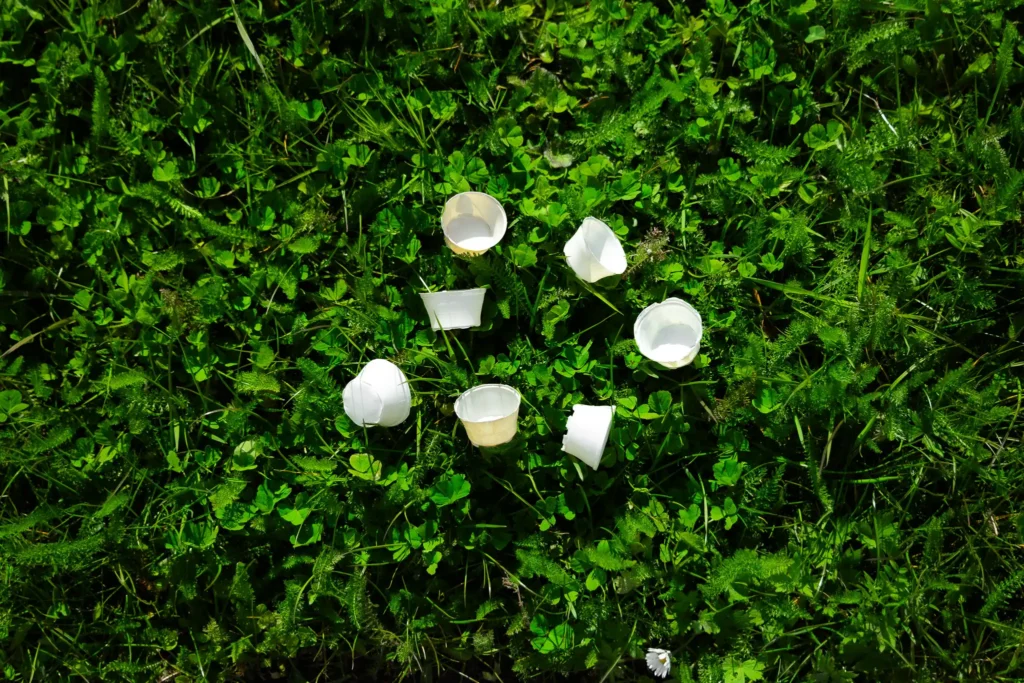
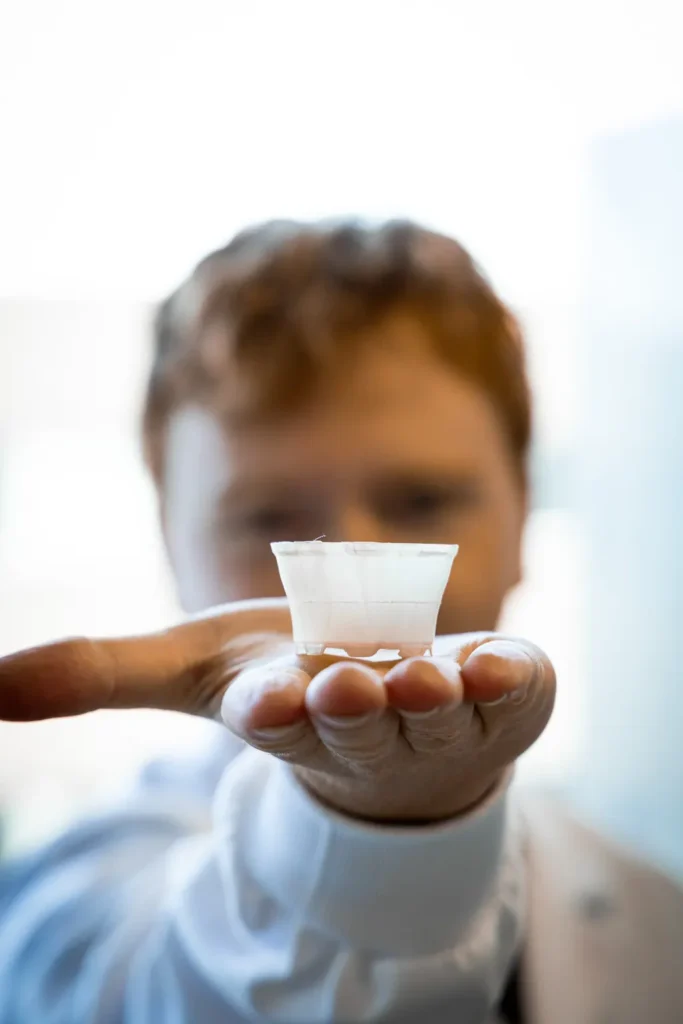
We make a medicine cup from bacterial cellulose. The cup is made of cellulose, with no coating, laminate or additives. There is no plastic in it. Our own data (details and source) It is meant for exactly the moments when a disposable cup is still needed. What bacterial cellulose is, you can read in What is bacterial cellulose?
A pilot is running at Maasstad Ziekenhuis in Rotterdam, where hospital staff test our cup during the medication round. Source (details and source) About the pilot at Maasstad Ziekenhuis
Do it in two steps
Reduce first, then replace. Do not do both at the same time. Then your purchasing data shows what each step achieves. That way you know what reducing did and what replacing adds.
Even with a better material, every cup still costs raw materials and energy. Replacing is therefore no reason to be less strict about reducing.
Ready for step 2 on your ward?
Sources and evidence
Everything we claim on this page, with the source, the conditions and the date we last checked it. Our own testing is marked as Internal test, plans as Goal. So you can check for yourself what each claim rests on.
Show all 6 sourcesHide sources
Estimate 300,000 plastic medicine cups a year: what a single hospital easily throws away
- Source
- Plastilose market analysis (2026)
- Conditions
- Order of magnitude, based on hospital consumption data from our interviews.
- Status
- Estimate
- Last checked
- 8 October 2026
Source Care organisation Amstelring used 629,000 plastic medicine cups in a year, for about 1,500 residents. That is just over one cup per resident a day.
- Source
- Amstelring, January 2026
- Conditions
- This is the only published consumption figure we found. The other consumption figures come from our own interviews.
- Status
- Source
- Last checked
- 8 October 2026
Source A plastic medicine cup has a footprint of about 11.2 g CO₂-eq; a paper one about 1.5 g.
- Source
- Samen de zorg vergroenen, intervention 'Medicijncupje van papier' (paper medicine cup)
- Link
- samendezorgvergroenen.nl/interventie/medicijncupje-van-papier (opens in a new tab)
- Conditions
- Per 30 ml cup, published by Samen de zorg vergroenen.
- Status
- Source
- Last checked
- 9 October 2026
Source Samen de zorg vergroenen advises wards to use fewer medicine cups by assigning a cup to one patient and reusing it. Reuse is not suitable for liquid medicines or crushed medication.
- Source
- Samen de zorg vergroenen, intervention 'Gebruik medicijncupjes verminderen' (use fewer medicine cups)
- Link
- samendezorgvergroenen.nl/interventie/gebruik-medicijncupjes-verminderen (opens in a new tab)
- Conditions
- This is the platform's recommendation for wards, not research by Plastilose.
- Status
- Source
- Last checked
- 10 October 2026
Our own data The cup is made of cellulose, with no coating, laminate or additives. There is no plastic in it.
- Source
- Plastilose product specification (2026)
- Conditions
- This follows from the composition of the product. We do not yet have a microplastics test report.
- Status
- Our own data
- Last checked
- 8 October 2026
Source A pilot is running at Maasstad Ziekenhuis in Rotterdam, where hospital staff test our cup during the medication round.
- Source
- Maasstad Ziekenhuis press release, 9 April 2026
- Link
- maasstadziekenhuis.nl/nieuws/pilot-medicijncupjes (opens in a new tab)
- Conditions
- No patients take part yet. We share results only after the joint publication with Maasstad, expected in early November 2026.
- Status
- Source
- Last checked
- 8 October 2026