
Knowledge
What is bacterial cellulose?
Cellulose that bacteria make themselves. It is the same substance as in plants, but bacteria make it into an almost pure sheet. That sheet is made of extremely thin fibres.
What is cellulose?
Updated 10 October 2026.
Cellulose is what plants use to make themselves rigid. Every plant cell has a wall, and that wall is mostly cellulose. It is the most common natural building material on earth. Wood, cotton, flax, hemp and bamboo are largely made of it. Part of the fibre in fruit and vegetables is cellulose too.
What does cellulose mean? The word comes from cell, cellula in Latin. The ending -ose is the one you often see in the names of sugars. Chemically, cellulose is a very long chain of glucose, a simple sugar. These chains lie side by side and together form strong fibres. That is how a tree stays upright.
You come across cellulose everywhere. Paper and cardboard are made of cellulose fibres from wood. Cotton clothing is almost pure cellulose. Tablets often contain it as a filler and food uses it as a thickener. People cannot digest cellulose. In your gut it acts as dietary fibre.
People have used cellulose for a very long time. Think of linen and cotton for clothing, and paper to write on. Today cellulose is also the raw material for viscose, a fabric for clothing, and for some films. Almost always, that cellulose comes from wood or cotton.
Is cellulose a plastic? No. Plastic is a synthetic material, usually made from crude oil. Cellulose is a natural substance that plants and some bacteria make themselves. There are plastics derived from cellulose, such as cellophane and cellulose acetate. To make them, the cellulose is chemically modified. That is something different from cellulose as it occurs in nature.
Cellulose, but made by bacteria
Some bacteria make cellulose too. They spin a dense network of fibres so thin you can only see them under a microscope. That network grows as a sheet on the surface of a liquid.
In plants, cellulose is bound to other substances, such as lignin. That is why turning wood into paper takes a lot of water, energy and chemicals. Bacterial cellulose does not contain those substances. The sheet is almost pure cellulose from the start.
Chemically, bacterial cellulose is the same substance as cellulose from plants. The difference is in its form. Bacterial fibres are much thinner than plant fibres and lie closer together. That makes the material behave differently. It can hold a lot of water, and once dried it becomes a strong, thin sheet.
In short, the main differences between cellulose from plants and cellulose from bacteria.
- Origin. Plant cellulose comes from wood, cotton or other crops. Bacterial cellulose is grown.
- Purity. In plants, cellulose is bound to lignin and other substances. Bacterial cellulose is almost pure.
- Fibres. Bacterial fibres are much thinner and form a dense network.
- Extraction. Cellulose from wood has to be freed chemically. Bacterial cellulose grows straight away as a sheet.
Bacterial cellulose has long been made at scale as nata de coco, a dessert from Southeast Asia. Source (details and source) We do not grow it to eat, but to make rigid disposables from it.
How is bacterial cellulose made?
Bacterial cellulose is not taken from nature but grown. That happens in a few steps. The details differ from maker to maker. This is the general picture.
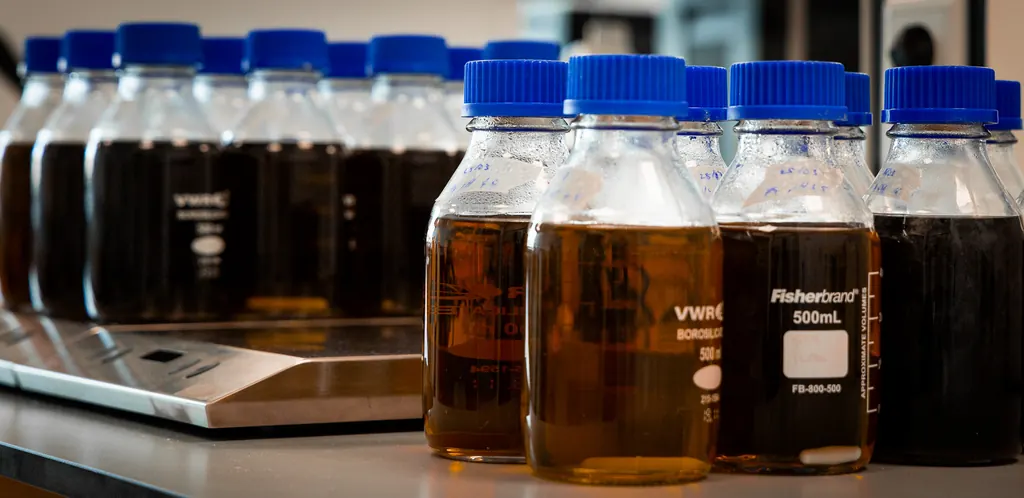
- Culturing. Bacteria are given a liquid with nutrients. They use those nutrients to make cellulose.
- Growing. A sheet of cellulose fibres grows on the surface of the liquid. It gets thicker for as long as the bacteria have food.
- Harvesting and cleaning. The sheet is lifted out of the liquid and washed. What remains is almost pure cellulose.
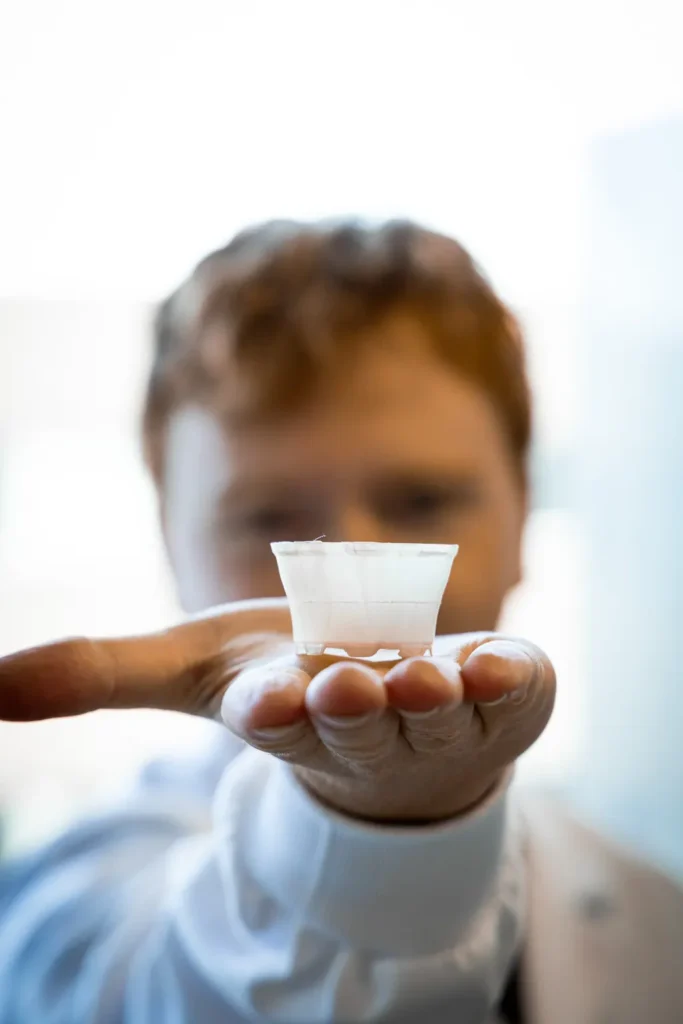
- Shaping and drying. The sheet is dried and shaped into a product. How we form it into a cup is our own innovation.
Our bacteria grow on side streams from the food industry, not on food itself. Our own data (details and source) We work with a wild-type bacterium that has not been genetically modified. We do not disclose which one. Our own data (details and source)
The sheet grows best on a liquid that stays still. That makes scaling up difficult. Want to know how we tackle that? Read how our technology works.
What the material can do
Dried bacterial cellulose grown on side streams reaches a tensile strength of 72 to 140 MPa, compared with about 30 to 40 MPa for polypropylene. Source (details and source) These values come from published research on the material. They do not apply to our formed cup. We will measure the cup ourselves on the pilot line.
In a published study, bacterial cellulose did not react chemically with the two medicines tested, ibuprofen and propranolol. This is published research on bacterial cellulose, not a test of our cup. Source (details and source)
Wet, bacterial cellulose is soft and flexible, a little like a damp cloth. Dried, it becomes stiff and strong. That makes it suitable for very different products, from a soft dressing to a rigid cup.
How it differs from paper and bioplastic
| Paper | Bioplastic, such as PLA or PHA | Bacterial cellulose | |
|---|---|---|---|
| What is it? | Cellulose fibres from wood | A plastic, made from plants or by bacteria | Cellulose, made by bacteria |
| How does it become a product? | Fibres are formed into a sheet with water | Melted and moulded, like ordinary plastic | The sheet is shaped into a product with our own innovation |
| Watertight? | Usually only with a coating | Yes | Formed cups hold liquid in our laboratory tests |
Paper disposable cups often have a plastic coating to make them watertight. Under EU rules that makes them a single-use plastic product. Source (details and source)
We have nothing against bioplastics. PHA, for example, breaks down well. The difference lies in the material itself. Bacterial cellulose is cellulose, while bioplastic is a plastic. Which material suits best differs per product and depends on how it is used.
For medicine cups we have set the three materials side by side in more detail. Read the comparison of paper, PLA and bacterial cellulose
What is bacterial cellulose used for?
Bacterial cellulose has been known for a long time, but only recently has it been studied for many different products. Below are the uses you most often find in research and at other makers. This is general knowledge about the material, not a list of what Plastilose makes.
- Food. As nata de coco, and as a thickener or fibre in foods.
- Healthcare. In research on wound dressings and compresses, because the material holds a lot of moisture. Also for disposables in healthcare, such as our medicine cup.
- Packaging. As a thin film or as a layer on paper, to make something that needs less plastic.
- Textiles. As an alternative to leather or as the basis for new fabrics.
- Skincare. In face masks that hold moisture.
- Engineering. In research on filters, insulation and thin membranes.
We start with the medicine cup. Every day, healthcare uses large numbers of cups that are thrown away after a few seconds. That is where a different material makes the most difference. A medicine cup has to be rigid, hold liquid and must not react with what is in it. Those are exactly the properties we are testing bacterial cellulose for. How to use fewer cups first and then replace the rest is explained in Reduce first, then replace.
Is bacterial cellulose safe?
Cellulose itself is one of the most widely used substances in food, medicines and personal care products. Bacterial cellulose has long been eaten as nata de coco. That makes it a familiar material.
Still, that does not tell the whole story. Whether a product is safe also depends on how it is made, what else is in it and what you use it for. Each kind of product has its own EU rules, for example for materials that come into contact with food. A maker has to show for each product that it meets those rules. A safe material does not automatically make a safe product.
For our cup we are therefore precise about what we do and do not know. The cup is made of cellulose, with no coating, laminate or additives. There is no plastic in it. Our own data (details and source) We use no PFAS and no coating. This is about what we use, not a test result. The cup has not yet been tested for fluorine. Our own data (details and source) The cup is supplied non-sterile. Our own data (details and source)
What PFAS are and why they are found in some paper cups is explained in Paper medicine cups, PFAS and the SUP Directive.
What happens when you throw it away
In a published study, bacterial cellulose lost about 75% of its mass in 8 weeks buried in soil. It was a greenhouse soil-burial test. It was done on the material, not on our cup. We do not have a compostability certificate. Source (details and source)
For now, a used cup simply goes in general waste, like a plastic cup. Our goal is a cup that can go in the organic waste after use and become compost. Goal (details and source)
What we do not know yet
- How strong the formed cup is, dry and wet. We will measure that on the pilot line from early 2027.
- How the cup holds up over a full medication round. We will measure that on the pilot line too.
- Whether the cup can go in the organic waste or the paper recycling. We are still testing that with waste processors.
Questions
Frequently asked questions about cellulose
What does cellulose mean?
Cellulose is the substance that gives plant cells their strength. The word comes from cell, cellula in Latin. Chemically it is a long chain of glucose. Wood, cotton and paper are mostly made of it.
Is cellulose a plastic?
No. Plastic is a synthetic material, usually made from crude oil. Cellulose is a natural substance from plants and some bacteria. There are plastics derived from cellulose, such as cellophane. In those, the cellulose has been chemically modified.
Is cellulose harmful?
Cellulose itself is widely used in food, tablets and personal care products. Your body does not digest it; it acts as dietary fibre. Whether a cellulose product is safe does depend on what else is in it and how you use it. Each kind of product has its own rules for that.
What is the difference between bacterial cellulose and paper?
Both are cellulose. Paper comes from wood. Getting the fibres out of wood takes water and chemicals. Bacterial cellulose grows straight away as an almost pure sheet, with much thinner fibres. Read the full comparison.
Is bacterial cellulose the same as PLA?
No. PLA is a bioplastic. It is made from plant starch or sugar, but it remains a plastic that is melted and moulded. Bacterial cellulose is not a plastic but cellulose. Paper, PLA or bacterial cellulose?
Is paper biodegradable?
Uncoated paper breaks down in nature because it is made of cellulose. Many paper cups and food packs do have a plastic layer to make them watertight. That layer does not break down in the same way and makes recycling harder.
What is bacterial cellulose used for?
As food, such as nata de coco, and in research on wound dressings, packaging, textiles and skincare. We use it to make disposables for healthcare, starting with the medicine cup.
Which bacterium do you use?
The strain is a trade secret. We work with a wild-type bacterium that has not been genetically modified.
Want to be among the first to try the cup?
Sources and evidence
Everything we claim on this page, with the source, the conditions and the date we last checked it. Our own testing is marked as Internal test, plans as Goal. So you can check for yourself what each claim rests on.
Show all 11 sourcesHide sources
Source Bacterial cellulose has long been made at scale as nata de coco, a dessert from Southeast Asia.
- Source
- Plastilose note on PHA and bacterial cellulose (2026), with literature
- Conditions
- This is about food, not rigid products.
- Status
- Source
- Last checked
- 8 October 2026
Our own data Our bacteria grow on side streams from the food industry, not on food itself.
- Source
- Plastilose process documentation (2026)
- Conditions
- We do not disclose which streams.
- Status
- Our own data
- Last checked
- 8 October 2026
Our own data We work with a wild-type bacterium that has not been genetically modified. We do not disclose which one.
- Source
- Plastilose process documentation (2026)
- Conditions
- The strain is a trade secret.
- Status
- Our own data
- Last checked
- 8 October 2026
Source Dried bacterial cellulose grown on side streams reaches a tensile strength of 72 to 140 MPa, compared with about 30 to 40 MPa for polypropylene.
- Source
- Militký et al., Polymers 18(11):1271 (2026)
- Link
- DOI 10.3390/polym18111271 (opens in a new tab)
- Conditions
- This is a property of the material as a dried film. Measurements on the formed cup follow on the pilot line from the first quarter of 2027.
- Status
- Source
- Last checked
- 25 August 2026
Source FTIR measurements show that bacterial cellulose does not react chemically with ibuprofen or propranolol. Only weak, reversible hydrogen bonds form.
- Source
- Jantarat et al., RSC Advances 11 (2021)
- Link
- DOI 10.1039/d1ra07761a (opens in a new tab)
- Conditions
- This is published research on bacterial cellulose, not a test of our cup.
- Status
- Source
- Last checked
- 8 October 2026
Source Paper disposable cups often have a plastic coating to make them watertight. Under EU rules that makes them a single-use plastic product.
- Source
- Directive (EU) 2019/904 (single-use plastics) and European Commission guidelines (2021/C 216/01)
- Link
- eur-lex.europa.eu/eli/dir/2019/904/oj (opens in a new tab)
- Conditions
- Applies to paper cups with a plastic lining or coating.
- Status
- Source
- Last checked
- 9 October 2026
Our own data The cup is made of cellulose, with no coating, laminate or additives. There is no plastic in it.
- Source
- Plastilose product specification (2026)
- Conditions
- This follows from the composition of the product. We do not yet have a microplastics test report.
- Status
- Our own data
- Last checked
- 8 October 2026
Our own data We use no PFAS and no coating.
- Source
- Plastilose product specification (2026)
- Conditions
- This is about what we use, not a test result. The cup has not yet been tested for fluorine.
- Status
- Our own data
- Last checked
- 8 October 2026
Our own data The cup is supplied non-sterile.
- Source
- Plastilose product specification (2026)
- Conditions
- This applies to the current supply. We do not claim that the cup is sterile.
- Status
- Our own data
- Last checked
- 8 October 2026
Source In a published study, bacterial cellulose lost about 75% of its mass in 8 weeks buried in soil.
- Source
- Bueno et al., Polymer Degradation and Stability 217:110535 (2023)
- Link
- DOI 10.1016/j.polymdegradstab.2023.110535 (opens in a new tab)
- Conditions
- It was a greenhouse soil-burial test. It was done on the material, not on our cup. We do not have a compostability certificate.
- Status
- Source
- Last checked
- 25 August 2026
Goal Our goal is a cup that can go in the organic waste after use and become compost.
- Source
- Plastilose (2026)
- Conditions
- This is a goal, not a property of today's cup. Today the cup goes in general waste. We are still testing organic-waste and paper-recycling routes with waste processors. Nothing has been agreed. We do not have a compostability certificate.
- Status
- Goal
- Last checked
- 8 October 2026