

For investors
Disposables without plastic. We start in healthcare.
We grow bacterial cellulose and turn it into disposables, starting with the medicine cup for hospitals. We are raising our seed round now. We discuss it only in person with investors. This page is not an offer of shares or other securities.
The story
Six steps, from problem to plan.
- 1
The problem
A plastic medicine cup is used for a few seconds and then incinerated. A single hospital can easily throw away 300,000 plastic medicine cups a year. Estimate (details and source)
- 2
The material
Bacterial cellulose is a network of extremely thin fibres that bacteria spin themselves. Dried, the material is stronger than polypropylene in published research. Source (details and source)
How it works - 3
The product
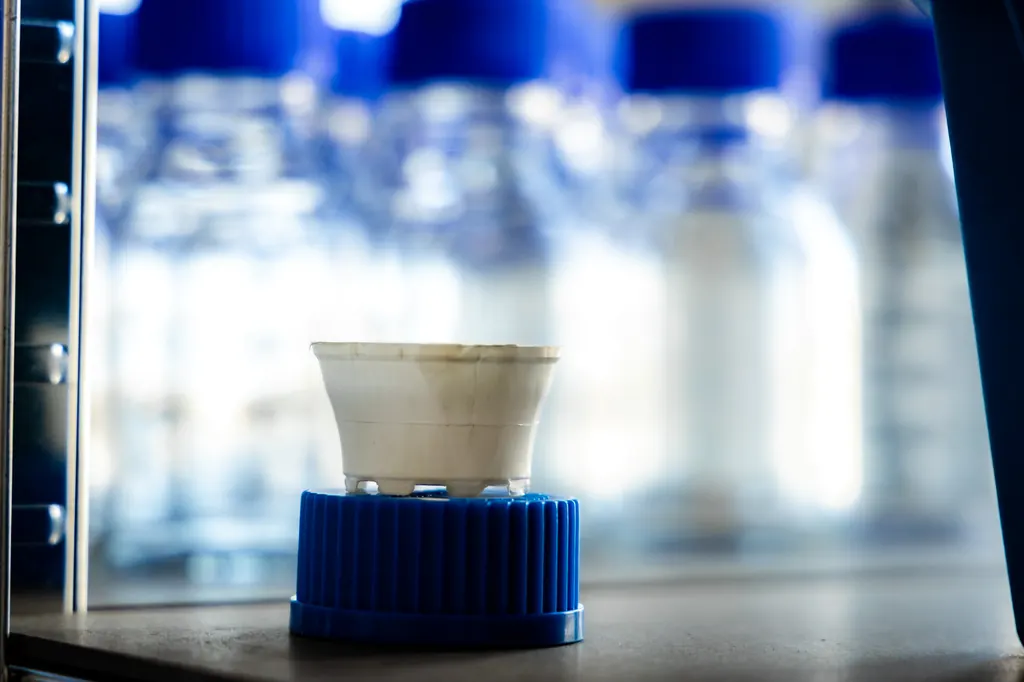
A 30 ml medicine cup. The cup is made of cellulose, with no coating, laminate or additives. There is no plastic in it. Our own data (details and source)
The cup - 4
The pilot
A pilot is running at Maasstad Hospital in Rotterdam, where hospital staff test our cup on the wards. Source (details and source)
Read about the pilot - 5
Scaling up
Large stirred tanks tear the cellulose sheet apart. So we scale up with more trays side by side, starting on a pilot line in Delft. Our own data (details and source)
- 6
The impact
Our own internal LCA indicates up to about 80% less CO₂ than a plastic cup. It is an internal cradle-to-grave estimate, discussed with an external LCA expert. Formal external verification is not yet complete. Depending on the scenario, the reduction is 48 to 83%. Estimate (details and source)
Already in place
No longer an idea on paper.
- Running since April 2026Pilot at Maasstad Hospital in Rotterdam.Source (details and source)
- 45+healthcare organisations and distributors have come to us unprompted since April 2026Our own data (details and source)
- Patent pendingDutch application, filed March 2026.Source (details and source)
- Winner, Nieuwe Heldenprijs 2026Plastilose won the Circular Economy category of the KVK Innovatie Top 100 2026.Source (details and source) Source (details and source)
In October 2026 the first sample cups go to hospitals that are considering a pilot. Our own data (details and source) We are supported by the City of Rotterdam (Circular Innovations) and Planet B.io. We also use the WBSO, the Dutch R&D tax credit. Source (details and source)
The plan
One production line first. Then licences to partners.
These are goals and plans, not forecasts or commitments. They depend on funding and on what we learn on the pilot line. Dates and numbers may change.
-
Now
Lab in Delft
Our manufacturing process is at TRL 4 to 5, with TRL 5 targeted for early 2027.
Our own data (details and source) -
End of 2026
Pilot line
A pilot line for about 10,000 cups a week, under construction in Delft, with the goal of running by the end of 2026.
Goal (details and source) -
2028 to 2030
Our own line
Our plan is our own production line for 1 million cups a week. We aim for the first cups at the end of 2028 and full capacity in 2030.
Goal (details and source) -
From 2030
Licences to partners
The first licence is planned for 2030. After that, partners can build factories with our process, each with a line of 1 million cups a week.
Goal (details and source)
After the medicine cup
Which products follow and when? Only the medicine cup is in development today. For the rest we can only give a direction. Goal (details and source)
In developmentGoal, provisional
| Product | Period |
|---|---|
| Medicine cup, 30 ml | 2026 to 2028, in development |
| Lid | 2028 to 2029, goal |
| Larger cups and coffee cups | 2029 to 2031, goal |
| Small trays and kidney dishes | from 2031, goal |
| Beyond healthcare | from 2029, goal |
Read where we are heading, from kitchen to factories worldwide
The market
Dutch healthcare alone uses tens of millions of cups a year.
Dutch healthcare uses an estimated 89 to 143 million plastic medicine cups a year. Our best estimate is 112 million. Estimate (details and source) This is our own calculation and has not been externally verified.
Medicine cups a year in Dutch healthcare, in millions
The bar runs from the low to the high estimate. The line is our best estimate. Estimate (details and source)
RangeBest estimate
| Sector | Low | Best estimate | High |
|---|---|---|---|
| Nursing and care homes | 42 | 51 | 71 |
| Hospitals | 23 | 30 | 35 |
| Disability care | 18 | 22 | 26 |
| Mental health care | 5 | 7 | 8 |
| Clinics and other care | 1 | 2 | 3 |
| Total | 89 | 112 | 143 |
The medicine cup is where we start, not where we stop. The medicine cup will be followed by a lid, then larger cups and coffee cups, then small trays and kidney dishes. Beyond healthcare we aim to make the first products from 2029. Goal (details and source)
Why now
Sustainable healthcare is already on the agenda.
Green Deal Duurzame Zorg
Care organisations that signed the Dutch Green Deal on sustainable healthcare work towards lower CO₂ emissions and less waste. Disposables are part of that.
CSRD and Scope 3
If you report on Scope 3, the emissions of the products you buy count too. That puts even a medicine cup in the report.
Milieuthermometer Zorg
With the Milieuthermometer Zorg, Dutch care organisations show how far they have come with sustainability. Waste and purchasing count towards it.
EU Packaging Regulation
Since 12 August 2026 the EU Packaging Regulation has restricted PFAS in food-contact packaging.
Source (details and source)
The team
Design, biology and engineering around one table.
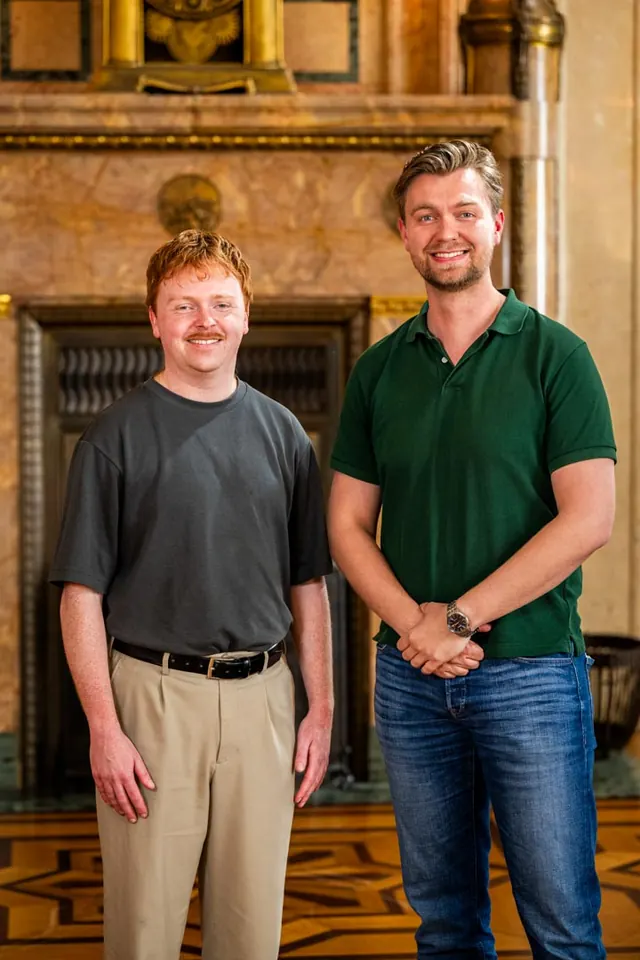
Jason started in 2024 with experiments in his own kitchen, then at BlueCity in Rotterdam. He worked out how to grow cellulose with bacteria and turn it into a rigid product. Joram joined to build a company around it.
Our team consists of two co-founders and five employees. We also have two advisers. Our own data (details and source)
Meet the whole team

Questions
What investors ask us.
Why are there no financial figures on the site?
We discuss forecasts, terms and the status of the round in person, in confidence. On this site we only publish what we can substantiate publicly.
What is in the deck?
The story, the market, the scale-up plan and the team. If you want to look further, we then share the business plan and a data room with you.
How far along is the technology?
The plan above shows it step by step, from where we are now to what comes next.
What is protected?
In March 2026 Plastilose filed a Dutch patent application. Source (details and source) We keep our strain, growth medium and exact process steps as trade secrets.
What is the biggest risk?
Scaling up. Making a cup in the lab is not the same as making a million a week, at the same quality every time and at a good price. That is why we are building a pilot line first, to measure everything we do not know yet.
Curious about the whole plan? Request our deck.
This page and our deck are not an offer of shares or other securities and not investment advice. We share the deck only after a short personal conversation. Investing in a young company is risky. You can lose your entire investment and your stake is usually hard to sell.
We use your details to reply and to keep track of who we speak with about the round. Read our privacy policy.
Another question? Get in touch
Sources and evidence
Everything we claim on this page, with the source, the conditions and the date we last checked it. Our own testing is marked as Internal test, plans as Goal. So you can check for yourself what each claim rests on.
Show all 23 sourcesHide sources
Estimate 300,000 plastic medicine cups a year: what a single hospital easily throws away
- Source
- Plastilose market analysis (2026)
- Conditions
- Order of magnitude, based on hospital consumption data from our interviews.
- Status
- Estimate
- Last checked
- 8 October 2026
Source Dried bacterial cellulose grown on side streams reaches a tensile strength of 72 to 140 MPa, compared with about 30 to 40 MPa for polypropylene.
- Source
- Militký et al., Polymers 18(11):1271 (2026)
- Link
- DOI 10.3390/polym18111271 (opens in a new tab)
- Conditions
- This is a property of the material as a dried film. Measurements on the formed cup follow on the pilot line from the first quarter of 2027.
- Status
- Source
- Last checked
- 25 August 2026
Our own data The cup is made of cellulose, with no coating, laminate or additives. There is no plastic in it.
- Source
- Plastilose product specification (2026)
- Conditions
- This follows from the composition of the product. We do not yet have a microplastics test report.
- Status
- Our own data
- Last checked
- 8 October 2026
Source A pilot is running at Maasstad Hospital in Rotterdam, where hospital staff test our cup on the wards.
- Source
- Maasstad Hospital press release, 9 April 2026
- Link
- maasstadziekenhuis.nl/nieuws/pilot-medicijncupjes (opens in a new tab)
- Conditions
- No patients take part yet. We published the first results together with Maasstad Hospital in November 2026.
- Status
- Source
- Last checked
- 16 November 2026
Our own data Bacterial cellulose grows as a sheet on a still liquid. Large stirred tanks, as used in most fermentation, tear that sheet apart. So rather than using bigger tanks, we scale up by adding more trays side by side.
- Source
- Plastilose market analysis (2026)
- Conditions
- This is our own analysis.
- Status
- Our own data
- Last checked
- 8 October 2026
Estimate Our own internal LCA indicates up to about 80% less CO₂ than a plastic cup.
- Source
- Plastilose internal life-cycle assessment (2026)
- Conditions
- It is an internal cradle-to-grave estimate, discussed with an external LCA expert. Formal external verification is not yet complete. Depending on the scenario, the reduction is 48 to 83%.
- Status
- Estimate
- Last checked
- 8 October 2026
Our own data 45+ healthcare organisations and distributors have come to us unprompted since April 2026
- Source
- Plastilose CRM records, October 2026
- Conditions
- Count from our customer system (CRM), cleaned in October 2026: no private individuals, duplicates or lost leads. We did no outreach in that period. Interest is not an order.
- Status
- Our own data
- Last checked
- 9 October 2026
Source Patent pending (Dutch application filed March 2026).
- Source
- Dutch patent application, filed 11 March 2026
- Conditions
- An application is not a granted patent.
- Status
- Source
- Last checked
- 8 October 2026
Source Winner of the Nieuwe Heldenprijs 2026.
- Source
- Nieuwe Heldenprijs 2026
- Link
- rotterdamseondernemersprijs.nl/2026/06/02/dura-vermeer-wint-rotterdamse-ondernemersprijs-2026 (opens in a new tab)
- Conditions
- Awarded on 2 June 2026.
- Status
- Source
- Last checked
- 8 October 2026
Source Category winner for Circular Economy in the KVK Innovatie Top 100 2026.
- Source
- KVK Innovatie Top 100, 2026
- Link
- wbn.nl/wijzuidholland/kvk-innovatie-top-100-3 (opens in a new tab)
- Conditions
- Awarded on 13 November 2026. This is the category prize, not the overall prize.
- Status
- Source
- Last checked
- 16 November 2026
Our own data In October 2026 the first sample cups go to hospitals that are considering a pilot.
- Source
- Plastilose (2026)
- Conditions
- We make them by hand in our Delft lab until the pilot line runs.
- Status
- Our own data
- Last checked
- 9 October 2026
Source We are supported by the City of Rotterdam (Circular Innovations) and Planet B.io. We also use the WBSO, the Dutch R&D tax credit.
- Source
- Plastilose business plan 2026-2036, version 4.1
- Conditions
- This support has been awarded. We do not disclose amounts.
- Status
- Source
- Last checked
- 8 October 2026
Our own data Our manufacturing process is at TRL 4 to 5, with TRL 5 targeted for early 2027.
- Source
- Plastilose internal assessment (2026)
- Conditions
- This is measured against the bioprocess, not the product.
- Status
- Our own data
- Last checked
- 8 October 2026
Goal A pilot line for about 10,000 cups a week, under construction in Delft, with the goal of running by the end of 2026.
- Source
- Plastilose business plan 2026-2036
- Conditions
- This is a target, not current output.
- Status
- Goal
- Last checked
- 8 October 2026
Goal Our plan is our own production line for 1 million cups a week. We aim for the first cups at the end of 2028 and full capacity in 2030.
- Source
- Plastilose business plan 2026-2036
- Conditions
- This is a plan that depends on financing.
- Status
- Goal
- Last checked
- 8 October 2026
Goal The first licence is planned for 2030. After that, partners can build factories with our process, each with a line of 1 million cups a week.
- Source
- Plastilose business plan 2026-2036
- Conditions
- This is a plan, not an agreement. No licence exists yet.
- Status
- Goal
- Last checked
- 8 October 2026
Goal In the long term we want to make 100 million products a week, on our own lines and with partners. The medicine cup is where it starts.
- Source
- Plastilose business plan 2026-2036
- Conditions
- This is an ambition, not a forecast.
- Status
- Goal
- Last checked
- 8 October 2026
Goal Medicine cup from 2026 to 2028. Lid from 2028 to 2029. Larger cups and coffee cups from 2029 to 2031. Small trays and kidney dishes from 2031. Beyond healthcare we aim to make the first products from 2029.
- Source
- Plastilose business plan 2026-2036, version 4.1
- Conditions
- The years are not fixed yet. Only the medicine cup is in development today.
- Status
- Goal
- Last checked
- 8 October 2026
Estimate Dutch healthcare uses an estimated 89 to 143 million plastic medicine cups a year. Our best estimate is 112 million.
- Source
- Plastilose market analysis (2026), based on public data from VZInfo and Statistics Netherlands (CBS), ActiZ, Zorgverzekeraars Nederland and the Monitor Langdurige Zorg
- Link
- plastilose.nl/en/healthcare/market-analysis/#sources-by-sector
- Conditions
- Our own bottom-up estimate, based on data from Statistics Netherlands (CBS), the RIVM and the Long-term Care Act (Wlz), plus more than 100 interviews with healthcare organisations around the turn of 2024 to 2025. Not externally verified.
- Status
- Estimate
- Last checked
- 8 October 2026
Estimate In millions of cups a year, with the best estimate in brackets. Nursing and care homes 42 to 71 (51). Hospitals 23 to 35 (30). Disability care 18 to 26 (22). Mental health care 5 to 8 (7). Clinics and other care 1 to 3 (2).
- Source
- Plastilose market analysis (2026), based on public data from VZInfo and Statistics Netherlands (CBS), ActiZ, Zorgverzekeraars Nederland and the Monitor Langdurige Zorg
- Link
- plastilose.nl/en/healthcare/market-analysis/#sources-by-sector
- Conditions
- Our own bottom-up estimate, not externally verified. Together 89 to 143 million, with 112 million as the best estimate.
- Status
- Estimate
- Last checked
- 8 October 2026
Goal The medicine cup will be followed by a lid, then larger cups and coffee cups, then small trays and kidney dishes. Beyond healthcare we aim to make the first products from 2029.
- Source
- Plastilose business plan 2026-2036
- Conditions
- This is an ambition. The order and timing after the medicine cup are not fixed yet.
- Status
- Goal
- Last checked
- 8 October 2026
Source Since 12 August 2026 the EU Packaging Regulation has restricted PFAS in food-contact packaging.
- Source
- Regulation (EU) 2025/40 (PPWR), Article 5
- Link
- eur-lex.europa.eu/eli/reg/2025/40/oj (opens in a new tab)
- Conditions
- This applies to food-contact packaging.
- Status
- Source
- Last checked
- 7 October 2026
Our own data Two founders, five employees and two advisers.
- Source
- Plastilose (2026)
- Conditions
- This is the position as of October 2026.
- Status
- Our own data
- Last checked
- 8 October 2026